Home Staging Before Selling: Is It Worth It in Almaden Valley?
Is home staging before selling worth it in Almaden Valley? Learn the costs, benefits, best rooms to stage, and when staging makes financial sense.
Mike D’Ambrosio · September 27, 2026 · 15 min read
Introduction
When you're preparing an Almaden Valley home for sale, staging can feel like one more expense added to an already crowded checklist.
Paint. Landscaping. Repairs. Photography. Inspections.
And now someone wants to replace your perfectly functional sofa because apparently it has committed a crime against real estate photography.
So, is home staging before selling actually worth paying for?
Often, yes — but not automatically.
The value of staging depends on the home, its condition, price point, target buyer, existing furniture, current competition, and how much presentation could improve buyer perception.
That's particularly important in Almaden Valley, where homes frequently compete in the $2 million-plus market and buyers may arrive with elevated expectations for condition and presentation. The local Sell Your Home page reported a $2.4 million median sale price in March 2026, a 109.5% sale-to-list ratio, and approximately 10 – 12 days on market for well-priced homes.
At those price levels, even a relatively small improvement in buyer response can represent meaningful money.
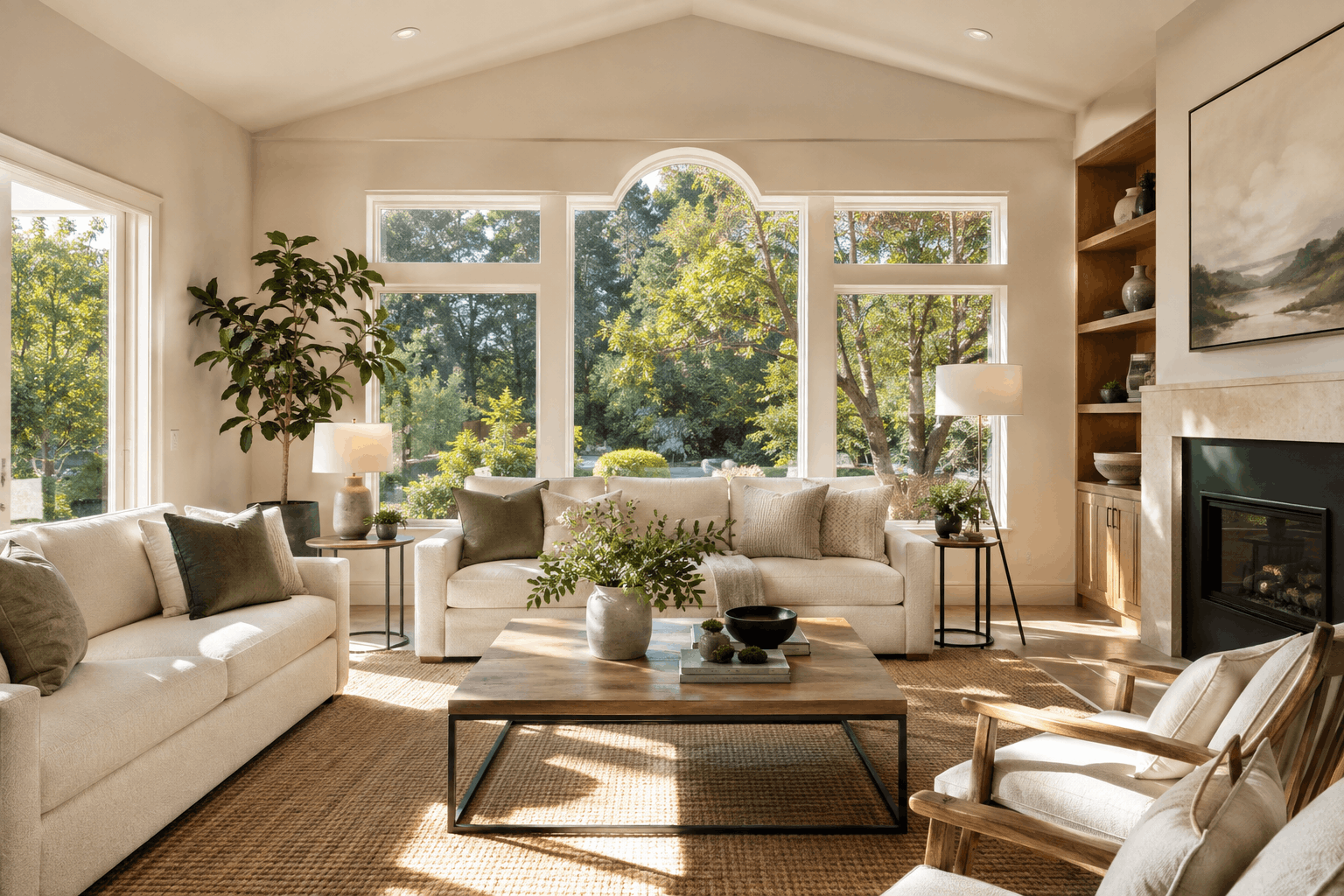
The objective of staging isn't to make your house look like a furniture showroom.
It's to make buyers understand the home's value quickly.
TLDR guide
Home staging before selling can be worthwhile when it helps buyers understand the property's space, functionality, lifestyle, and strongest features.
According to the National Association of Realtors® 2025 Profile of Home Staging, 83% of buyers' agents said staging made it easier for buyers to visualize a property as their future home. NAR also reported that 29% of real estate professionals saw staged homes receive a 1% – 10% increase in the dollar value offered, while 49% of sellers' agents observed some reduction in time on market.
Staging may make the most sense when:
- The home is vacant
- Existing furniture makes rooms feel smaller
- Décor is highly personalized
- The layout is difficult to understand
- The property competes in a luxury price range
- Buyers have several similar homes to choose from
- Professional photography will benefit significantly
- The home has strong architectural features worth highlighting
Staging may require a lighter touch when:
- The home is already professionally furnished
- The layout is obvious and photographs well
- The property needs major repairs that staging cannot disguise
- The staging expense would be disproportionate to the likely benefit
The key question isn't:
"Does staging make a house prettier?"
It usually does.
The better question is:
"Will staging improve this property's market position enough to justify the investment?"
Detailed Breakdown
1. What Does Home Staging Actually Do?
Home staging is not the same thing as decorating.
Decorating reflects your taste.
Staging is designed around buyer perception.
The goal is to present each important room so buyers can quickly understand:
- Its purpose
- Its scale
- Furniture placement
- Traffic flow
- Natural light
- Architectural features
- Lifestyle potential
NAR describes staging as presenting a property in a way that highlights its strengths and helps buyers imagine themselves living there, often through decluttering and strategic styling rather than remodeling.
That's an important distinction.
Staging isn't trying to convince buyers that your house is something it isn't.
It is trying to stop distracting furniture, clutter, or awkward presentation from hiding what the house already does well.
2. Why Staging Can Matter More in Almaden Valley
In a high-value market, buyer expectations tend to rise with the price.
A buyer touring a $900,000 starter home may tolerate dated furniture and an awkwardly arranged bedroom.
A buyer considering a multimillion-dollar Almaden Valley property may expect a more polished experience.
The local guide to How to Sell Your House Fast in San Jose emphasizes that buyers in premium Almaden Valley neighborhoods pay attention to presentation, layout functionality, home condition, and long-term maintenance. It also recommends professional staging, decluttering, neutral presentation, lighting improvements, and strong photography as part of preparing a property for market.
In other words:
At higher price points, buyers aren't simply comparing houses.
They're comparing experiences.
3. Staging Can Help Buyers Visualize the Home
This is probably staging's strongest argument.
According to NAR's 2025 research, 83% of buyers' agents said staging made it easier for buyers to visualize the property as their future home.
That matters because many buyers aren't naturally good at imagining space.
An empty 14-by-16-foot room might look small.
Place an appropriately scaled bed, side tables, rug, and chair in it, and suddenly the buyer understands:
"Oh. This is a proper primary bedroom."
The same principle applies to:
- Great rooms
- Dining areas
- Home offices
- Bonus rooms
- Outdoor spaces
Staging helps answer the buyer's unspoken question:
"How would I actually live here?"
4. Which Rooms Matter Most?
You do not necessarily need to stage every square foot.
NAR's 2025 report found the most commonly staged rooms were:
- Living room – 91%
- Primary bedroom – 83%
- Dining room – 69%
- Kitchen – 68%
Buyers' agents ranked the living room as the most important room to stage, followed by the primary bedroom and kitchen.
For an Almaden Valley property, I would generally prioritize:
- Living or family room
- Kitchen
- Primary bedroom
- Dining area
- Entry
- Home office
- Outdoor entertaining space
These are the places where buyers tend to imagine daily life.
Nobody has ever offered $100,000 over asking because the linen closet changed their worldview.
Spend where perception matters.
5. Vacant Homes Can Benefit Significantly
Empty homes create a particular problem.
Without furniture, buyers may struggle to understand scale.
Rooms can look:
- Smaller
- Colder
- Less functional
- More generic
Vacancy can also draw attention toward every wall mark, floor imperfection, and unusual architectural transition.
Strategic staging gives buyers visual reference points.
A living room becomes a place to entertain.
A bedroom becomes a comfortable retreat.
An odd nook becomes a home office.
Vacant staging can be particularly useful for higher-end properties because luxury buyers often expect listing photography to communicate a lifestyle rather than simply document empty rooms.
6. Occupied Homes May Need Editing More Than Full Staging
Not every seller needs a truckload of rented furniture.
Sometimes the best staging strategy is subtraction.
For an occupied property, preparation may involve:
- Removing oversized furniture
- Repositioning existing pieces
- Decluttering shelves
- Reducing personal photographs
- Clearing countertops
- Editing artwork
- Simplifying bedrooms
- Removing excess rugs
- Organizing closets
- Adding neutral accessories
The goal is not to erase every sign that human beings lived there.
It's to make the architecture easier to see.
Your furniture should support the house.
The house should not look like it is renting a small corner from your furniture.
7. Staging and Decluttering Are Closely Connected
Decluttering is one of the highest-impact components of home staging before selling.
The local How to Sell Your House Fast in San Jose guide specifically recommends removing excess furniture, clearing counters, organizing closets, minimizing personal décor, and simplifying room layouts.
Why?
Because clutter makes buyers notice possessions instead of property.
It can also make:
- Rooms feel smaller
- Storage feel inadequate
- Photography look busy
- Layouts seem less functional
A useful rule:
If an item doesn't help sell the room, consider removing it.
You don't need to throw anything away.
Storage units exist for a reason.
8. Staging Works Better After Basic Repairs
Staging is not camouflage.
If the house has:
- Peeling paint
- Damaged flooring
- Broken fixtures
- Visible leaks
- Cracked caulking
- Neglected landscaping
putting expensive furniture next to the problem does not make the problem disappear.
It makes the furniture look expensive.
Before staging, handle the obvious issues that could undermine buyer confidence.
The How to Increase Home Value Before Selling guide addresses strategic improvements sellers can consider before listing, while the local preparation guide specifically recommends minor repairs, lighting updates, paint, cleaning, and exterior improvements.
Presentation works best when the underlying property feels cared for.
9. Does Staging Actually Increase Sale Price?
It can.
But sellers should be skeptical of anyone promising a guaranteed percentage.
NAR's 2025 research found that 29% of real estate professionals reported a 1% – 10% increase in the dollar value offered for staged homes. Among sellers' agents specifically, 19% reported offers increasing 1% – 5% compared with similar unstaged properties.
That does not mean staging automatically adds 5% to every house.
Plenty of other factors affect price:
- Location
- Condition
- Inventory
- School boundaries
- Lot
- Pricing strategy
- Competition
- Interest rates
- Marketing
The safer conclusion is:
Staging can improve buyer perception, and improved buyer perception may strengthen demand and offers when the rest of the listing strategy supports it.
10. Small Percentage Differences Matter More at Almaden Prices
This is where Almaden Valley changes the math.
Suppose staging and presentation contribute to even a 1% difference in the outcome of a hypothetical $2.5 million sale.
That's:
$25,000.
At 2%:
$50,000.
This does not mean staging caused those numbers or guarantees that return.
It demonstrates why sellers of high-value homes should evaluate staging based on potential outcome rather than simply saying:
"Furniture rental sounds expensive."
The relevant question is return on investment.
11. Can Staging Help a Home Sell Faster?
Potentially.
NAR's 2025 report found 30% of sellers' agents observed slight decreases in time on market after staging, while 19% reported significant reductions.
Again, staging isn't the only factor affecting selling speed.
Pricing matters enormously.
So do condition, photography, inventory, and buyer demand.
The local Sell Your Home page makes exactly that point, reporting roughly 10 – 12 median days on market when priced right and emphasizing that well-priced homes attract competition while inflated listings may struggle.
The winning combination is usually:
Preparation + Staging + Photography + Pricing + Exposure
Not staging alone.
12. Photography Makes Staging Even More Important
Most buyers meet your house online first.
That means staging isn't only preparing the property for people walking through the door.
It's preparing the property for the camera.
NAR's staging research found 73% of buyers' agents considered listing photos more or much more important to their clients, while 88% of sellers' agents viewed photography as an important listing component.
Good staging helps photography communicate:
- Scale
- Flow
- Natural light
- Lifestyle
- Architectural features
- Outdoor living
The local San Jose selling guide also describes professional photography as effectively essential for modern listings, particularly in mid-to-upper-tier markets.
If you're going to stage, coordinate the staging and photography.
The camera should be part of the strategy from the beginning.
13. Luxury Homes Often Need More Intentional Presentation
Luxury buyers are evaluating more than bedrooms and bathrooms.
They may be buying:
- Indoor-outdoor living
- Entertaining space
- Architecture
- Views
- Privacy
- Lifestyle
- Design
The guide to Selling Luxury Homes in San Jose and Almaden Valley emphasizes that high-end properties require intentional positioning rather than generic listing tactics.
Staging can help tell that story.
A large patio becomes an entertaining environment.
A dramatic great room becomes the social center of the home.
A view becomes the backdrop to everyday life.
Luxury staging should not simply make the property look expensive.
The property is already expensive.
It should make the value understandable.
14. Don't Overstage the Home
There is such a thing as too much staging.
Every surface doesn't need:
- Three books
- One vase
- Two wooden beads
- An aggressively folded throw blanket
Buyers are purchasing the property.
Not auditioning for a lifestyle catalog.
Overstaging can make rooms:
- Feel smaller
- Look artificial
- Distract from architecture
- Photograph poorly
Good staging feels almost invisible.
You notice the home first.
15. Virtual Staging Has a Place — but Know Its Limitations
Virtual staging can be useful for vacant properties, particularly when physical staging is impractical.
NAR notes that virtual staging can help demonstrate furniture placement and décor without physically furnishing the home.
But buyers should not be surprised when they arrive.
If images are virtually staged, they should be clearly represented as such according to applicable advertising and MLS rules.
Virtual staging helps buyers imagine potential.
Physical staging allows them to experience it.
For a luxury Almaden listing, that distinction may matter.
16. Use Recently Sold Homes as a Presentation Benchmark
Before deciding how far to take staging, study the competition.
Review Recently Sold Homes and pay attention to how successful listings were presented.
Look at:
- Furniture scale
- Color palette
- Photography
- Landscaping
- Outdoor presentation
- Room usage
- Decluttering
- Lighting
The site's sold inventory currently includes multiple San Jose 95120 transactions, providing some useful local context, although the page also notes that its listing data is representative and not yet a live MLS feed.
The goal isn't to copy another house.
It's to understand the standard buyers are seeing.
17. When Full Staging May Not Be Worth It
Full staging isn't automatically appropriate.
You may decide against it when:
- The existing furniture already presents extremely well
- A limited styling consultation could achieve the same objective
- Major repairs deserve the budget first
- The home will be marketed primarily for redevelopment
- The anticipated gain does not justify the staging expense
- The property's strongest selling points are relatively independent of décor
The correct staging plan can range from:
Declutter and rearrange
to
Remove nearly everything and professionally furnish the property.
There is no virtue in choosing the most expensive option.
The best strategy is the one that produces the strongest likely return.
18. Build Staging Into the Broader Selling Strategy
Staging should never be treated as an isolated task.
It should work with:
- Pricing
- Repairs
- Paint
- Landscaping
- Photography
- Video
- Listing launch
- Showing strategy
- Offer timing
Almaden Valley Realtors recommends beginning the selling conversation well before the listing date, allowing time to make decisions about what should stay, what should go, and which updates are justified. Its Sell Your Home process says many seller conversations begin six to twelve months before launch.
That is a much better time to make staging decisions than three days before photography.
A Practical Home Staging Before Selling Checklist
Step 1: Determine the Target Buyer
Think about who is most likely to purchase the home and what they need to understand immediately.
Step 2: Evaluate the Existing Furniture
Identify pieces that help demonstrate scale and pieces that make rooms look crowded.
Step 3: Declutter Aggressively
Remove excess belongings, personal collections, crowded furniture, and countertop clutter.
Step 4: Address Repairs First
Fix obvious maintenance issues before spending heavily on décor.
Step 5: Prioritize Key Rooms
Focus primarily on living areas, the primary bedroom, kitchen, dining spaces, and important outdoor areas.
Step 6: Improve Lighting
Maximize natural light and address dim fixtures where practical.
Step 7: Coordinate With Photography
Make sure furniture placement and styling work from the camera's perspective.
Step 8: Compare Against Current Competition
Understand how other homes in your price range are being presented.
Step 9: Evaluate the Cost Against Potential Return
Spend intentionally.
The objective is not maximum staging.
It's maximum outcome.
Key Takeaways
- Home staging before selling is designed to help buyers understand the property's space, functionality, and lifestyle — not simply make it prettier.
- NAR's 2025 study found that 83% of buyers' agents said staging helped buyers visualize a property as their future home.
- NAR also found that 29% of real estate professionals reported a 1% – 10% increase in the dollar value offered for staged properties, although staging does not guarantee a particular return.
- Nearly half of sellers' agents in the same study observed some reduction in market time for staged homes.
- The living room, primary bedroom, kitchen, and dining room are among the most important areas to prioritize.
- Vacant homes can benefit from furniture that helps buyers understand room scale and functionality.
- Occupied homes may require strategic editing and decluttering rather than complete furniture replacement.
- Staging should follow basic repairs, cleaning, and other preparation — not attempt to disguise unresolved maintenance problems.
- Almaden Valley's multimillion-dollar price points make even relatively small improvements in buyer response financially meaningful.
- Professional staging becomes particularly important when presentation standards are high, as discussed in Selling Luxury Homes in San Jose and Almaden Valley.
- Sellers should review How to Increase Home Value Before Selling before deciding whether staging or another improvement deserves priority.
- Reviewing Recently Sold Homes can provide useful context for the presentation standard buyers are encountering.
- Strong staging works best alongside intelligent pricing, photography, preparation, and marketing.
- Sellers can begin planning through the Sell Your Home resources from Almaden Valley Realtors.
FAQs
1. Is home staging before selling worth the money?
Home staging before selling can be worthwhile when it improves buyer perception, photography, room functionality, and the home's competitive position. NAR's 2025 research found that 29% of real estate professionals reported staged properties receiving 1% – 10% more in dollar value offered, although those results are not guaranteed for every home. Sellers should compare the staging cost against the home's price point, existing condition, competition, and likely improvement in presentation.
2. How much of my house should I stage before selling?
You do not necessarily need to stage every room. The highest-priority spaces typically include the living room, primary bedroom, kitchen, and dining area, which NAR identified among the rooms most important or commonly staged. Less-important rooms can often be handled with cleaning, decluttering, and simple furniture adjustments.
3. Should I stage an empty house?
Vacant homes can benefit from staging because furniture helps buyers understand room scale, layout, and possible uses. An empty room can sometimes appear smaller or harder to interpret in listing photography than the same room with appropriately scaled furniture. For higher-value Almaden Valley listings, physical staging may also help communicate the lifestyle expected at the property's price point.
4. Can staging help my Almaden Valley home sell faster?
It may, particularly when staging improves first impressions and works alongside appropriate pricing and marketing. NAR found that 30% of sellers' agents reported slight reductions in market time for staged properties and another 19% reported significant reductions. Sellers focused on speed can also review How to Sell Your House Fast in San Jose for additional preparation and pricing strategies.
5. Should I stage my home or renovate before selling?
That depends on the property's condition and which investment is most likely to improve buyer response. Obvious repairs and maintenance issues generally deserve attention before expensive furniture staging because décor cannot compensate for major visible problems. Sellers can use How to Increase Home Value Before Selling and the Sell Your Home process to prioritize improvements before committing to a staging budget.

Mike D’Ambrosio
Lead Agent · Realtor®
Mike has lived in Almaden Valley for fifteen years. He has represented buyers and sellers in every neighborhood between Pioneer and Leland boundaries. He believes the right home is a generational decision, not a quarterly transaction.